

Silicone Hose
Product Overview
Qianli Rubber supplies industrial-grade silicone hoses engineered for high-temperature, high-pressure fluid and air transfer in demanding operating environments. Built using premium virgin silicone polymers and multi-ply fabric reinforcements (Polyester or Aramid), our hoses maintain mechanical integrity and flexibility under extreme thermal cycling. Designed for direct OEM replacement and custom industrial assemblies, every batch undergoes burst pressure and dimensional verification prior to shipment.
-
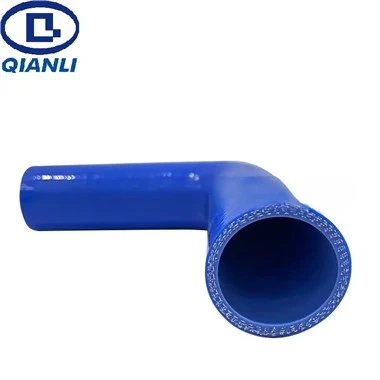 Silicone ElbowSilicone elbow refers to silicone hose that appears to “L” “U” shape, and also with special-shape, named “special-shape silicone hose”.Add to Inquiry
-
 Silicone Vacuum HoseVacuum silicone hose is mainly used for the connection of the vacuum pipe system. The character of flexibility makes it available to stand the vacuum suction force to avoid the strike force. It isAdd to Inquiry
-
 Silicone Turbo HoseSilicone turbo hose adopt weaving technology, inner and outer layers are both high quality silicone material, and with weaving reinforcement in the medium. Silicone hose has widely application, andAdd to Inquiry
-
 Silicone ReducerSilicone reducer is made from high quality silicone material. It is of 3 layers structure, inner layer is 100% high quality silicone, cover silicone and reinforcement 4 layers polyester/glass fiber.Add to Inquiry
-
 Silicone HoseSilicon hose is made of silicone material. It is usually used to transfer liquid, gas and other medium. It can be divided into two kind for “extrusion hose” and “heterotropic hose”. It widely used inAdd to Inquiry
-
 Hump HoseInner and outer layer are both high performance silicone material, and with wire reinforcement in the medium, and it is generally wavy shape.Add to Inquiry


- Tel: +86-318-6668206
- Fax: +86-318-6668207
- manager@hebeiqianli.com
- Add: West industrial Zone, Jing County, Hengshui City, Hebei Province, China.
Key Features & Benefits
Thermal Endurance: Operates continuously from -50°C to +180°C (standard VMQ) or up to +250°C (high-temp grades), resisting hardening, cracking, and ozone degradation.
Multi-Ply Fabric Reinforcement: Embedded with 3 to 5 plies of woven polyester or high-tensile aramid (Kevlar) fabric to withstand high working pressures and prevent radial expansion (ballooning).
Smooth Inner Bore: Extruded with a seamless, non-porous inner liner that minimizes fluid turbulence and prevents particulate buildup in coolant and air lines.
Electrochemical Resistance: Resistant to engine coolants, anti-freeze, water, and oil mist, reducing the risk of polymer breakdown over extended service intervals.
Dimensional Stability: Precision-wrapped on steel mandrels to ensure uniform inner diameters and wall thickness tolerances within ±0.5mm.
Technical Specifications
|
Technical Parameter |
Standard Specification |
High-Temperature / Heavy-Duty Specification |
|
Material Base |
VMQ (Vinyl Methyl Silicone) |
FVMQ (Fluorosilicone) or High-Purity VMQ |
|
Reinforcement |
3-Ply / 4-Ply Woven Polyester Fabric |
4-Ply / 5-Ply Aramid (Kevlar) Fabric |
|
Temperature Range |
-50°C to +180°C |
-60°C to +250°C (Peaks to +300°C) |
|
Inner Diameter (ID) |
6mm to 300mm (0.24in to 11.8in) |
Custom tooling available up to 500mm |
|
Wall Thickness |
4.5mm to 5.5mm (Standard 4-ply) |
Up to 8.0mm (Heavy-duty applications) |
|
Working Pressure |
0.3MPa to 1.2MPa (Size dependent) |
Up to 2.5MPa (Aramid reinforced) |
|
Burst Pressure |
Min. 3x Working Pressure |
Min. 3x Working Pressure |
|
Compliance |
SAE J20 R4 / ISO 9001:2015 |
SAE J20 Class A / IATF 16949 aligned |
Applications
Commercial Vehicles & Heavy Equipment
Turbocharger compressor discharge lines, charge air cooler (CAC) hoses, radiator coolant inlet/outlet pipes.
Automotive Aftermarket & Performance
Custom turbo piping, intercooler connections, and high-flow induction systems.
Industrial & Marine Machinery
Generator set exhaust connections, compressor intake lines, water cooling circuits, and chemical processing fluid transfer.
Railway & Transit
Traction motor cooling ducts and pneumatic control air lines operating under continuous vibration.
Product Selection Guide
Selecting the correct silicone hose requires evaluating operating parameters to prevent premature failure. Use the following criteria:

Fluid & Chemical Compatibility
Standard silicone (VMQ) handles water, coolants, and air.
For continuous exposure to petroleum oils, fuels, or aggressive hydrocarbons, specify fluorosilicone (FVMQ) liners.
Pressure Rating Calculation
Verify both maximum working pressure and pressure spikes (surge). Ensure the selected wall thickness and fabric ply count provide a safety factor of at least 3:1 against burst pressure.
Pressure Rating Calculation
Verify both maximum working pressure and pressure spikes (surge). Ensure the selected wall thickness and fabric ply count provide a safety factor of at least 3:1 against burst pressure.
Configuration Type
• Straight Hoses: General fluid transfer and vibration isolation.
• Reducer Hoses: Connecting piping components of differing diameters.
• Elbow Hoses (45°, 90°, 135°): Routing around engine blocks or structural frames without kinking.
• Hump Hoses: Accommodating thermal expansion and engine rock in heavy-duty powertrains.

OEM Services & Custom Manufacturing
Qianli Rubber provides custom engineering and manufacturing services based on your technical drawings, CAD models, or physical samples.
Custom Geometry & Tooling
In-house mandrel development for non-standard bends, custom leg lengths, and integrated bead rings or wire reinforcement.
Private Labeling & Branding
Customized exterior finish (glossy, matte, wrapped texture) with laser-etched part numbers, logos, and traceability barcodes.
Specialized Constructions
Integration of stainless steel inner coils for vacuum collapse resistance or fluoro-elastomer inner barriers for fuel resistance.
Prototyping & Sampling
Rapid sample production utilizing CNC mandrel tooling to validate fit, form, and function prior to mass production.
Quality Control & Testing
To guarantee field reliability, every production lot undergoes rigorous physical and mechanical testing in our QC laboratory:
Raw Material Inspection: Verification of polymer Mooney viscosity, filler dispersion, and tensile strength on incoming silicone compound batches.
Burst Pressure Testing: Hydrostatic pressure testing performed on sample pieces from each production run to verify compliance with burst thresholds. (Visual reference suggestion: Insert real photo of the hydrostatic burst pressure testing rig).
Dimensional Verification: Laser and caliper measurement of inner diameters, wall thickness, and leg lengths against engineering drawings.
Hardness & Density Testing: Shore A durometer testing (typically 65±5 Shore A) to ensure consistent vulcanization hardness.
Traceability: Batch numbers molded directly onto the hose exterior linked to complete raw material and production machine logs.

Frequently Asked Questions

Request a Quote (RFQ)
Submit your technical specifications, drawings, or estimated annual volume to receive a formal quotation from our engineering team.
Required RFQ Details
Inner Diameter (ID) and Wall Thickness
Hose Type (Straight, Reducer, Elbow, Hump)
Operating Pressure and Temperature Requirements
Working Fluid (Coolant, Air, Oil, etc.)
Estimated Annual Quantity / Delivery Schedule
As one of the most professional silicone hose manufacturers and suppliers in China, we have world-leading production equipment and strong manufacturing capabilities. Please feel free to buy bulk durable silicone hose made in China here from our factory.
silicone hose, Silicone Reducer, Silicone Vacuum Hose